
You probably know the basics of how your car’s engine works. If not, or if you’re interested in learning more, let’s discuss this interesting topic with you.
The engine works thanks to fuel and in turn drives the wheels. In general, to fully understand how a car works, you don’t need to study aerodynamics, electronics, or the chemical formulas of lubricants and coolants. Overall, it’s quite simple.
However, if you want to get the most out of your car, we recommend that you still explore the details, how everything works from the inside and, even more importantly, how you can influence it.
Therefore, in our upcoming articles we will start telling you more and in greater detail about the engine and its processes. And we will focus on engine oil.
Why does a car need oil?
A car moves thanks to fuel combustion and the resulting driving force. Simply put, the fuel‑air mixture enters the engine cylinder (shown below), where the piston compresses it, causing a spark and combustion.
The generated energy is transferred to the crankshaft, which in turn drives the wheels, and thus the car.
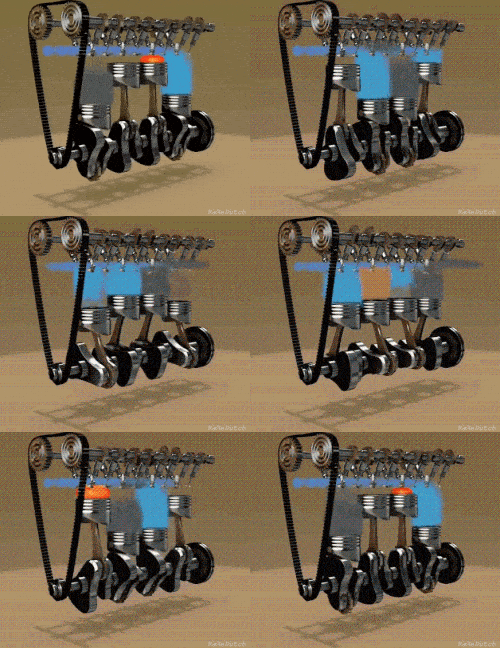
The main component in this process is the large number of places where metal‑on‑metal friction occurs. Obviously, these friction points require thorough lubrication throughout operation.
Without this, engine parts wear out quickly, leading to malfunctioning or less efficient operation.
To make this lubrication possible, oil is delivered from the oil pan to all such locations (where metal contacts metal). The main components are the pistons, the crankshaft, as well as the camshaft. Afterward, the oil returns to the oil pan for another cycle.

As you can see, this procedure significantly reduces friction in critical engine junctions where temperatures can reach 300ºC.
The presence of oil is also essential for temperature control to avoid failures.
When should engine oil be changed?
Of course, oil cannot work correctly forever. After circulating through the engine and lubricating all parts, a significant amount of debris and residues from fuel combustion, soot, and dust accumulate. Over time this causes the oil to lose its properties and effectiveness. Then it needs to be changed.
This is also affected by your driving style and the vehicle’s design. Often, you may not notice a deterioration in oil quality and its combustion. This can happen if oil enters the cylinder and mixes with fuel before combustion. If this process starts, the consequences can become much worse!
To prevent this, we recommend regularly changing the engine oil and checking whether the indicator has activated, signaling a problem.
Depending on your vehicle and the type of oil used (synthetic or mineral), it is recommended to perform this change every 10,000‑30,000 kilometers of mileage, or every 1‑2 years. However, each car is unique, so we advise you to find the recommendations for your model, or contact our specialists for advice.
If you have a modern car that runs on synthetic oil, it can last up to 30,000 kilometers.
In cases where the car is older than 10 years or you use mineral oils, the oil should be changed more frequently.
If you’re curious about when and how best to change the oil, refer to your vehicle’s manual, where this information is usually listed. Also, of course, if your current oil viscosity is higher than recommended, it’s better to stick with the one you have, as variations in these characteristics can negatively affect performance.
What is your experience with changing engine oil? Have you encountered any quirks? What would you recommend?