Despite all their advantages, modern transport engines have one serious drawback, which nevertheless cannot be blamed. It cannot be blamed because nothing in the world is perfect. In energy production, harmful environmental consequences are still unavoidable. Since the most widespread source of mechanical energy on Earth is the internal combustion engine, we must first do something with engines so that the harm caused by their extraordinary prevalence does not outweigh the benefits.
The conflict situation is obvious. Where there is conflict, there is war. A quiet, undeclared, but combat operation aimed at giving engines high environmental performance has been underway for more than a decade, and so far it cannot be said that people are winning this battle. Engines are increasing, environmental requirements are becoming stricter. Yet there are not many ways to meet them.
For the sake of fairness, it should be noted that humanity does have a secret weapon capable of radically solving the task of providing high environmental performance for engines. As early as the 1960s, Professor V.M. Kushul of the Leningrad Research Institute of Aviation Instrumentation proposed an engine design that practically produces no harmful emissions. The fuel charge in this engine burns at 99%, allowing it to be described as a smokeless design. However, for a number of reasons, including the unconventional nature of this engine's arrangement, this solution has not gained widespread adoption. It is quite possible that the automotive world is simply waiting for Kushul's design to be called the invention of Carmelo Scuderi, who is noted for implementing the Soviet 1960s development in 2001 in America and presenting it to SAE engineers under the name Split‑Cycle Combustion (SCC). One way or another, engine designers worldwide continue to look for ways to solve this pressing issue in their own way. It should be said that sometimes these attempts take on a rather interesting form.
In 2001, Kushul's engine magically became the invention of the American Carmelo Scuderi.
Soot as a Reason to Worry
Among the recent developments on this front, the proposals of a whole range of well‑known companies to ensure high environmental safety, primarily for modern diesel engines, stand out. The fact is that despite the known advantage of diesel in terms of thermal efficiency, it is still imperfect regarding harmful emissions. In particular, the most unattractive indicators for diesel engines are the high content of nitrogen oxides and the soot produced in the exhaust as a by‑product of mechanical energy generation. Yes, ordinary soot, in the form of unburned hydrocarbon residues that exit the diesel and take on a form dangerous to humans. The issue is that fine dust particles smaller than 5 µm are not expelled from the human body. Particles of hydrocarbon even smaller than that constitute the soot emissions from a diesel engine. And although nitrogen oxide, another diesel problem, is far more hazardous in its effects on living organisms, it contributes to an increased risk of cancer; nevertheless, the primary task that engine developers decided to tackle was the removal of soot from diesel exhaust. The solution, given all this, was not easy. But reasoning that if, with such a combustion organization that reduces soot in the exhaust, the share of carcinogenic nitrogen oxides inevitably rises, it would be better for the engine to produce more soot, which is easier to eliminate than the highly dangerous nitrogen‑oxide product.
In tackling the problem of eliminating soot‑forming solid particles from diesel exhaust, designers chose not to take the simple route. Of course, the issue could have been solved by installing a replaceable soot filter, analogous to the principle used for the well‑known air filter. However, discovering that such a soot filter clogs quickly due to uneven deposition of solid particles, the automotive industry, concerned about the environment, decided that a trivial victory over mere uneven clogging of a replaceable soot filter would not impress diesel enthusiasts. Therefore, a decision was made to implement far more extravagant and exotic designs on a large scale. Thus, in full accordance with the popular perception of diesel engines as extremely high‑technology products, a variety of, inevitably eye‑catching, systems and devices for cleaning diesel’s harmful soot emissions began to appear on the market like mushrooms after rain.
One of the first in this direction was the well‑known leader – Mercedes‑Benz with its BlueTEC cleaning system, based on the use of urea as a means to eliminate the harmful effects of its diesel vehicles.
The urea consumption (ADBlue reagent, a solution of water and ammonia) required for the operation of the cleaning system on this principle is about 100 ml per 100 km, and therefore should not frighten anyone with the prospect of high additional costs. Moreover, in California, for example, people are willing to incur even lower costs for clean air. As for the rest of the world, it is less fortunate. The magic‑urea system cannot help everyone. This is because the ADBlue reagent proved not to be as resistant to low temperatures and freezes already at minus 11 °C.
ADBlue is the registered trademark of the product AUS 32 (aqueous urea solution, 32%). Copyright belongs to the German Automotive Industry Association (VDA). It is used as an auxiliary working fluid in diesel engines with SCR technology – Selective Catalytic Reduction.
Naturally, taking this circumstance into account, Mercedes‑Benz did not stop at offering the Bluetec system exclusively to the market. However, the further development of diesel exhaust cleaning systems was no longer so extraordinary and fully aligned with what Mercedes’ competitors, who never rest, are doing in this field. It should be noted that the competitors also do not sleep. While Mercedes was mastering the urea system, the market was offered alternative diesel particulate filter systems. Today the market is familiar with two types of such systems: a diesel particulate filter system that uses fuel additives (FAP) and one that does not use fuel additives (DPF).
FAP is not better than DPF
In terms of construction, FAP and DPF systems differ radically. The basis of FAP is a principle of operation that is somewhat similar to Bluetec. To clean the diesel engine exhaust, the FAP system also uses injection of a liquid reagent into the engine’s exhaust manifold. However, this is not for the same purpose as in Bluetec. Instead of a chemical reaction, in the case of FAP a special gelled diesel fuel solution containing micro‑granules of cerium bound in jelly‑like capsules is fed into the exhaust tract. Post‑injection of this consistency occurs at the moment when the engine’s exhaust valves are open and a flow of hot exhaust gases passes through them. During the delivery of the solution, the jelly‑like capsules evaporate, and as a result cerium particles enter the soot FAP filter, where, in the presence of carbon and oxygen, they create local combustion hotspots with temperatures reaching 1000 °C. Naturally, with such an arrangement the soot burns efficiently in a regime that is most gentle to the filter’s ceramic. Advantages of this type of soot‑filter system probably include the selectivity of the process. The local temperature rise occurs precisely in the areas where more soot deposits. The second indisputable plus is the filter’s indifference to its mounting location in the exhaust tract. The cleaning temperature when using an FAP filter will be reached under any conditions, even if the filter itself is located quite far from the exhaust valves that emit the hot exhaust.
To achieve uninterrupted operation of a DPF soot filter, the control system involves numerous sensors that are not present in a gasoline engine.
1. Instrument panel. 2. Electronic control unit. 3. Air flow sensor. 4. Diesel engine. 5. Temperature sensor before the turbocharger. 6. Turbocharger. 7. Temperature sensor before the soot filter. 8. Oxygen sensor (lambda). 9. Soot filter (DPF). 10. Pressure drop sensor on the soot filter. 11. Temperature sensor after the soot filter.
Naturally, the blue‑sky dream of every diesel exhaust soot‑filter designer has been and remains a system that allows its effective use without the need for additional consumables, such as cerium‑containing gel or even ammonia with water. In pursuit of this dream, designers introduced DPF soot‑cleaning systems. Indeed, why bother with consumables and supply some cerium when it is sufficient simply to place a ceramic soot filter near the exhaust valves, and the high temperature of the exhaust gases from a high‑output engine will by itself clean the soot deposits from the filter, burning the previously accumulated soot. Everything brilliant is simple – the designers realized this. They brought these systems to market as a product of exceptional engineering‑marketing ingenuity.
The DPF exhaust cleaning system for a diesel engine works quite easily. The pressure sensor in the exhaust manifold provides the engine ECU with data on the filter's contamination level. The ECU calculates the volumetric airflow, which is measured by the air flow meter and the exhaust gas temperature sensor upstream of the soot filter. A separate temperature sensor mounted on the intake manifold before the turbo provides data on the exhaust gas temperature directly at the cylinder outlet. Based on the data from these sensors, the engine ECU calculates the timing of additional fuel injection, whose purpose is solely to raise the temperature in the area of the soot filter so that this increase ensures the burnout of accumulated soot in the filter. The system can calculate the required timing quite accurately. In addition to the listed sensors, data from the oxygen sensor installed before the catalyst are also taken into account. Consequently, the heating of the soot filter and its regeneration occur in an optimal mode.
The construction of a DPF soot filter is a matrix structure made of ceramic (silicon carbide) housed in a metal casing. All cells of the matrix are parallel channels that are alternately open and closed on one side (intake and exhaust), separated by filtering walls coated with zirconium and aluminum oxides. These filtering walls serve as a catalyst substrate that facilitates chemical reactions without forming new compounds and remains unchanged itself. Because the filter has a porous structure with alternating closed channels, the exhaust gases pass through the porous walls and soot particles in the intake ports. The diesel DPF is a closed‑type filter. When exhaust gases pass through it, particles of soot as small as 0.11 µm are retained. Most modern diesel vehicles have a soot filter combined with an oxidation catalyst located at the front of the filter. It performs the functions of both a soot filter and a catalyst simultaneously.
As can be seen, the DPF cleaning system, thanks to this simple and presumably inexpensive set of measures, is fully capable of protecting a diesel vehicle owner from unnecessary consumable expenses, practically delivering the same effect as using conventional replaceable filters. However, it is important to remember that for the desired effect all vehicle systems must operate flawlessly. The failure of even a single sensor can cause the entire system to become costly.
There is another unpleasant aspect. When the DPF filter reaches 105–125 % saturation, the system simply will not start due to the fire risk caused by a clogged soot filter. However, there are no problems as long as this risk is kept in mind throughout the vehicle’s service life. A diesel engine with a DPF designed for 120,000 km can fully and honestly exhaust its intended lifespan if the fuel is of good quality and the owner does not refuse to periodically drive at least 40 km at high speed with a downshift engaged. It is more convenient to do this at night, when dense traffic does not hinder prolonged high‑rpm engine operation, providing optimal conditions for soot burnout in the filter. If, for any reason, the filter becomes so clogged that the engine loses power and cannot even maintain the rated idle speed, this does not yet mean the soot filter must be replaced immediately, even though its price starts at $1,000. Of course, much depends on mileage and operating conditions. However, if everything is normal, a relatively simple procedure—soot filter cleaning—can assist eco‑conscious users employing high‑technology methods.
Soot filter that has melted. This occurs when a clogged filter is burned out by driving with full throttle and the driver abruptly lifts off the throttle. A large amount of oxygen enters the filter, causing the temperature to rise uncontrollably.
Unhealthy consequences of caring for health
Legends literally circulate among those who have faced the need to replace a soot DPF filter about its ability to be washed with even household‑available agents. It is said that the filter can be rinsed with plain water, pressurized and directed into the filter opposite to the flow direction of the exhaust gases. According to experimenters, special success can be expected if one uses a dishwashing detergent that is effective in other everyday situations. There is an opinion to test something that apparently no one has succeeded with yet, that such an approach to solving the problem might help. Well, an experiment is, of course, a noble endeavor, so why not try, while already stocking a brand‑new filter. In this case many things can be tried: from solvent to moonshine, perhaps luck will favor you. However, remembering that carbon deposits accumulate in the filter and, under high temperature and pressure fluctuations, become compacted in the narrow, repeatedly looping passages of the filter, at least to avoid permanently ruining a tightly clogged filter, it is better to turn to professional cleaning agents. Unlike plumbing chemicals, this automotive chemistry is designed primarily to first effectively loosen the soot that has coked the filter channels, and then efficiently remove the resulting fluffy mass, using the filter’s own operating principle.
Considering the growing number of vehicles in operation with diesel engines equipped with DPF filters, the market offers a whole range of chemical cleaning agents for clogged soot filters. There is no doubt that, for the most part, all these liquids are capable of handling the task assigned to them. However, the most effective product can still be identified by paying close attention to the cleaning technology recommended by the product’s manufacturer. From this perspective, the Xenum DPF FLUSH (STEP 1 and STEP 2) product looks attractive.
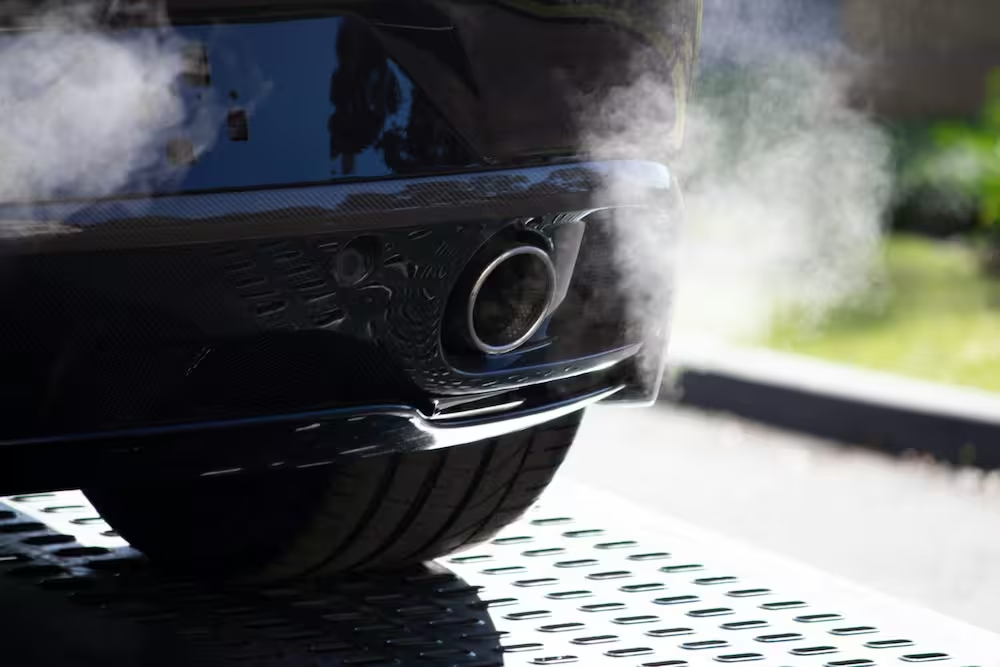
The manufacturer of this filter‑cleaning kit provides a configuration that allows cleaning without removing the filter, using the technological holes where the sensor mounts are located. The cleaning itself is carried out in several stages, with the engine’s normal operation and the filter regeneration system used between them. The STEP 1 and STEP 2 agents, introduced into the exhaust system, effectively loosen the soot deposit, giving the standard system the ability to handle the excess soot. No exotic chemistry, but that is where the product’s effectiveness lies. After all operations are completed, the product’s manufacturer recommends the same procedure as the vehicle manufacturer: at least 20 minutes of driving with the engine running at over 2500 rpm. During this time the engine’s exhaust system will finally expel the combustion products of the soot from the filter, which should be evident from dense smoke exiting the tailpipe. After the procedure the vehicle is ready for further use.
Prevention Is Smarter Than Treatment
Of course, this method of cleaning a soot filter is more cumbersome than the often‑practiced radical removal of it from the vehicle’s exhaust system with parallel emulation of sensor operation to keep the engine running. Nevertheless, it should be remembered that by choosing this route the vehicle owner inadvertently becomes a killer of the people around him and seriously endangers his own health. Whether one is willing to make such sacrifices or simply use automotive‑chemistry products periodically that solve the problem without those sacrifices is a personal decision. In the spectrum of options—removing the filter, replacing it with a new one, or opting for periodic cleaning—each owner will choose the most optimal and sensible solution. Moreover, Xenum, besides offering a remedy for advanced cases, also provides a preventive product that helps avoid critical soot‑filter blockage.
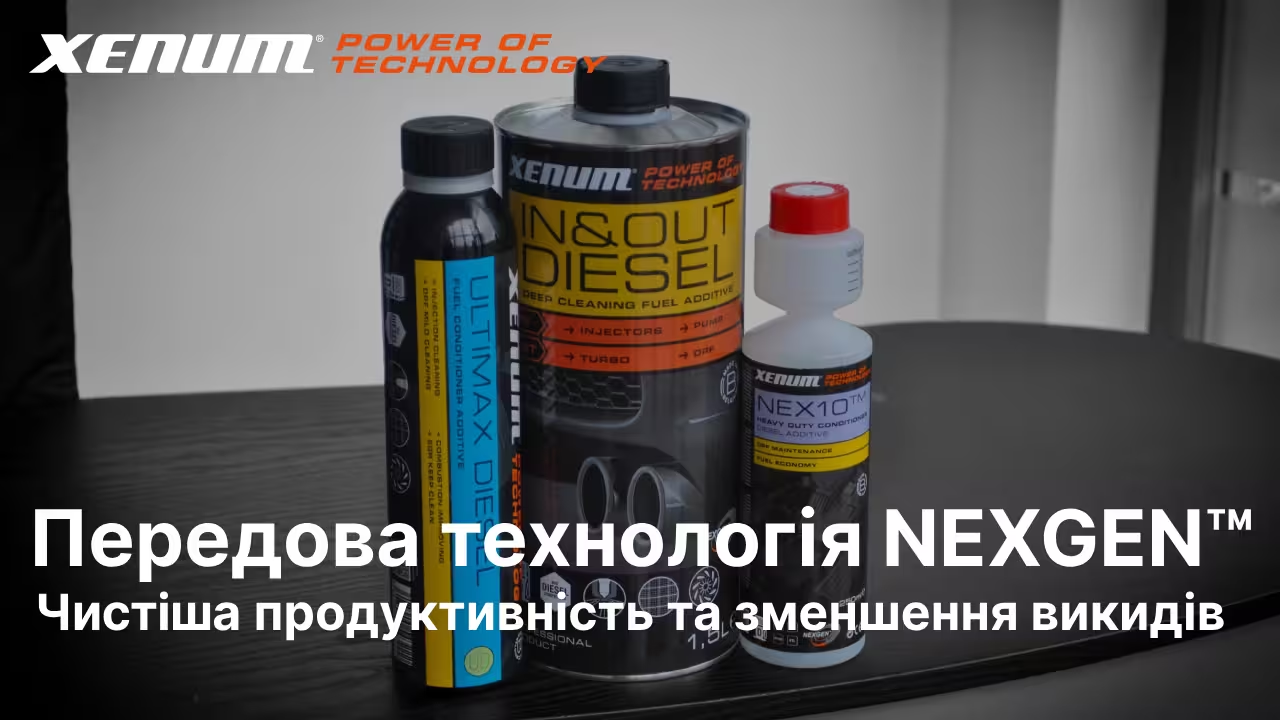
The preventive product Xenum IN & OUT CLEANER, operating on the company’s proprietary and patented NEXGEN technology, addresses the prevention of extreme soot‑filter clogging with a method reminiscent of FAP‑filter technology. This fuel additive contains particles of rare‑earth metals that, when deposited in the areas of highest soot accumulation within the filter, trigger a high‑temperature localized reaction that burns off excess carbon. Xenum’s solution is notable because the company claims that gelatin capsules are not needed as a delivery medium for the reaction activators to the soot‑rich zones. Moreover, the additive works more broadly, also cleaning the intake system. The technology is interesting in that the developer demonstrates approaches that, according to them, surpass the methods of well‑known manufacturers.
Epilogue
In war, all means are good. Today car manufacturers solve the task of selling their products like a commander who, by order to take care of his soldiers' health, forces those very soldiers to run after tanks that are choking, that are advancing, in gas masks sold to them at a similar price. But running like that won’t be enough for any health!
A nervous breakdown caused by the unpredictability of soot filter behavior is no better than the smoky air from engines running without them. Both are equally unacceptable in the relationship between car manufacturers and users of this equipment. Moreover, what is valuable in this situation is that technology developers come to the rescue, solving the problem at a cost level acceptable to the market.
It will probably continue in the same way. In any case, as long as the giants of automobile manufacturing treat examples of successful problem solving, such as the Kushul engine, with the same level of attention they give today to the real problems of their product's consumers. If the environmental issue is that important, it must be addressed constructively, not by creating consumer problems and significantly increasing operating costs. The consumer should not have to pay for ecological safety from the outset, as the technology is claimed to be safe for them. Yet even if they are forced to do so, a solution will always be found. Of course, with all the consequences this has for the manufacturer's reputation. War is war…